Tuesday, 4 October 2016

WORLD ANIMAL DAY


World Animal Day is an International Day of Action for Animal Rights and Welfare celebrated annually on October 4, the feast day of Francis of Assisi, the patron saint of animals. The mission of World Animal Day, according to the official World Animal Day website is "To raise the status of animals in order to improve welfare standards around the globe. Building the celebration of World Animal Day unites the animal welfare movement, mobilizing it into a global force to make the world a better place for all animals and pets such as Cats. It's celebrated in different ways in every country, irrespective of nationality, religion, faith or political ideology. Through increased awareness and education we can create a world where animals are always recognized as sentient beings and full regard is always paid to their welfare."


Man & Animals - Once Companions, now Enemies?

Anyone can be pretty sure that there was a time when man and animals were in harmony. As time passes by, both seems to be in a struggle to live on. Still the sight of busy passerby vanishing ahead, vehicles storming, along with innumerable four footed legs wandering along for a shelter is very common and thought provoking.  Without the natural protection, nor protection that humans are privileged to (though the sight of unprivileged humans finding solace atop pavements at nights is no better), animals mostly suffer for reasons not produced by them.  Animals, though unlike the the more mighty Nature cannot retaliate much. Their retaliation is seen as a threat to the present day Busy Bodies.

Swinging wildly between wanton killing of dogs and extreme ‘pro-life’ interventions, India has never framed a rational, scientifically valid dog ownership or population control strategy

Everyday, India wakes up to horrific stories of attacks on people by street dogs and equally horrific acts of cruelty towards dogs. There is extreme polarization on this issue between the advocates of human rights versus animal rights. The lack of a critical and scientific analysis is glaring.
A dog is considered to be man’s best friend, but there is, unfortunately, a dark side to having dogs on streets. More than 20 million people in India are bitten by dogs, and 20,000 die because of rabies, annually. Dogs also directly kill a dozen or more people, mostly children, every year.


Confused legislation
India, with the third highest dog population in the world, has some confused legislation to deal with this problem. In 2001, the Ministry of Culture issued the Animal Birth Control (Dogs) Rules, or the ABC rules, under the Prevention of Cruelty to Animals Act, 1960 (PCA Act). According to the ABC Rules, the population of street dogs must be controlled with sterilisation surgeries and these dogs are to be released from where they were caught.

However, these ABC Rules contravene the PCA Act in several places. Take Section 2(f) of the PCA Act, for instance, where an owner of an animal “…includes not only the owner but also any other person for the time being in possession or custody of the animal, whether with or without the consent of the owner.” This means that once municipal authorities and animal welfare organisations pick up free roaming dogs from the streets (and these dogs are unclaimed by anyone), they lawfully become the owners of those animals.
Further, Chapter 3, subsection 11 of the PCA Act clearly lists the responsibilities of owners and makes it an offence to “abandon any animal in circumstances which render it likely that it will suffer pain by reason of starvation or thirst”, or “wilfully” permit any animal that is “affected with contagious or infectious disease or, without reasonable excuse, permits any diseased or disabled animals… to die in any street.”
By the logic of this subsection, the biggest offenders under the PCA Act are the state and animal welfare organisations themselves as they capture and then release dogs back on the streets. While the ABC Rules are silent on who is ultimately responsible for these animals, the PCA Act is clear.
There are also contradictions within the ABC Rules. Subsection 7(9) states: “…female dogs found to be pregnant shall not undergo abortion (irrespective of stage of pregnancy) and sterilisation and should be released till they have litter.” This means that the law meant to control stray dog populations suggests that dogs should be born on the streets!
Commendably, India became one of the first countries globally to provide rights to domestic animals so that they may be protected against cruelty. However, the ABC Rules, in requiring the release of unclaimed dogs to an unsupervised life on the streets where nobody is held responsible, directly undermine the spirit and the letter of the law.

 An exalted position
These self-contradictory rules place street dogs in an administrative grey zone. They are not owned by anyone but are not wildlife either. Municipal and State authorities are duty-bound to control any animal, whether mosquitoes or rats, that can spread diseases to humans (under various Municipal Acts). However, ABC Rules prohibit the confinement or killing of dogs unless they are mortally wounded or sick. But what is bizarre is that the rules also forbid euthanising suspected rabid animals. Instead, they demand that these dogs be kept in isolation till they die a “natural” but slow, horrible death. Thus, neither people nor dogs are protected. Such an exalted position is not given to any other animal in India.
This extreme level of protection for dogs is unheard of even in countries with strict animal welfare laws. The removal and euthanasia of unowned dogs is routinely practised throughout the developed world. For example, in 2013, the Humane Society of the U.S. euthanised 3.4 million unowned dogs and cats. In the U.K., an owned dog that is considered dangerous can be “destroyed” and the owner penalised or jailed. These laws accept that the welfare of companion animals is best served in homes rather than on the streets.

Belling the wrong dog
What is the cost of the dog problem in India? Other than the terrible human costs associated with direct and indirect fatalities, the treatment of 20 million bite cases annually runs to hundreds of crores of rupees, and results in the loss of 38 million man-hours (2003 survey). A large number of vehicle accidents result from collision with or avoidance of dogs. The cost of the ABC programmes implemented across the country alone runs into several crores, but this is just a drop in the bucket compared to what it would actually cost to fix the problem.
The ABC programme as implemented will not result in bringing down the dog population in India for several reasons. One, it is logistically and operationally challenging to sterilise 50 millions dogs. Two, unsterilised dogs will always “spill over” into areas where sterilisation has been done. Three, the infrastructure needed for such large-scale surgical interventions do not exist. Instead, shady NGOs currently keep and operate on dogs in deplorable conditions. These are examples of real animal cruelty.

For more than a century, India has swung wildly between wanton killing of dogs and extreme “pro-life” interventions. It has never framed a rational, scientifically valid, and widely implementable dog ownership or population control strategy. We need to make a decision; to call dogs our best friends should mean that we don’t abandon them on streets. The street is no place for a dog — both for the welfare of humans as well as for dogs.
Abi T. Vanak is Fellow, Wellcome Trust/DBT India Alliance Programme, and Fellow, Ashoka Trust for Research in Ecology and the Environment. Aniruddha Belsare is with the Department of Fisheries and Wildlife Sciences, University of Missouri, Columbia, U.S. Meghna Uniyal, who contributed to this article, is an independent legal researcher.

Sunday, 2 October 2016

INTERNATIONAL DAY OF NON - VIOLENCE


The International Day of Non-Violence is observed on October 2, the birthday of Mahatma Gandhi. This day is referred to in India as Gandhi Jayanti.
In January 2004, Iranian Nobel laureate Shirin Ebadi had taken a proposal for an International Day of Non-Violence from a Hindi teacher in Paris teaching international students to the World Social Forum in Bombay. The idea gradually attracted the interest of some leaders of India's Congress Party ("Ahimsa Finds Teen Voice", The Telegraph, Calcutta) until a Satyagraha Conference resolution in New Delhi in January 2007, initiated by Indian National Congress President and Chairperson of the United Progressive Alliance Sonia Gandhi and Archbishop Desmond Tutu, called upon the United Nations to adopt the idea.
On 15 June 2007 the United Nations General Assembly voted to establish 2 October as the International Day of Non-Violence. The resolution by the General Assembly asks all members of the UN system to commemorate 2 October in "an appropriate manner and disseminate the message of non-violence, including through education and public awareness."
The United Nations Postal Administration(UNPA) in New York City prepared a special cachet to commemorate this event, following a request from the Indian Ambassador at the Permanent Mission of India to the UN. The boxed pictorial cachet design was prepared by the UNPA and was limited to cancellation at UNPA's NY location (not Geneva and Vienna). The UNPA has indicated that all outgoing UNPA mail between October 2 and 31 carried the cachet.

HAPPY GANDHI JAYANTI


Gandhi Jyanthi is a national festival celebrated in India to mark the occasion of the birthday of Mohandas Karamchand Gandhi, the "Father of the Nation". It is one of the three national holidays of the country. Though the title is not officially declared, asthe Constitution of India does not permit a father of the nation, it is mostly conferred to him. The United Nations General Assembly announced on 15 June 2007 that it adopted a resolution which declared that 2 October will be celebrated as the International Day of Non-Violence.

Gandhi Ji was preacher of Satyagraha (truth) and Ahinsa (non-violence). He lived for people’s happiness and always motivated others to do the same. His noble thought and love for mankind made him popular across the world. Gandhi Ji is remembered as a moralist who awakened the whole world and fought relentlessly to end up the discrimination of cast, creed and color. At present, he is not alive but, his principles are still alive in the heart of every Indian. On October 2, the whole nation stands and salutes the priceless service that Gandhi Ji had given to the people of India. Gandhi Jayanti is a national holiday and thus, all offices, schools and other organizations across the country remain closed.


READ GANDHIJI'S AUTOBIOGRAPHY AT
 http://www.mkgandhi.org/linktoautobio.htm

Thursday, 29 September 2016

WORLD RABIES DAY


World Rabies Day is an international campaign coordinated by the Global Alliance for Rabies Control, a non-profit organization with headquarters in the United States and the United Kingdom. It is a United Nations Observance and has been endorsed by international human and veterinary health organizations such as the World Health Organization, the Pan American Health Organization, the World Organisation for Animal Health (OIE), the US Centers for Disease Control and Prevention, the World Veterinary Association., and the American Veterinary Medical Association. World Rabies Day takes place each year on September 28, the anniversary of the death of Louis Pasteur who, with the collaboration of his colleagues, developed the first efficacious rabies vaccine. World Rabies Day aims to raise awareness about the impact of rabieson humans and animals, provide information and advice on how to prevent the disease, and how individuals and organizations can help eliminate the main global sources.
  LOVE THE DOG, HATE THE BITE  

WORLD TOURISM DAY - SEPTEMBER 27

Since 1980, the United Nations World Tourism Organization has celebrated World Tourism Day on September 27. This date was chosen as on that day in 1970, the Statutes of the UNWTO were adopted. The adoption of these Statutes is considered a milestone in global tourism. The purpose of this day is to raise awareness on the role of tourism within the international community and to demonstrate how it affects social, cultural, political and economic values worldwide.
At its Twelfth Session in Istanbul, Turkey, in October 1997, the UNWTO General Assembly decided to designate a host country each year to act as the Organization's partner in the celebration of World Tourism Day. At its Fifteenth Session in Beijing, China, in October 2003, the Assembly decided the following geographic order to be followed for World Tourism Day celebrations: 2006 in Europe; 2007 in South Asia; 2008 in the Americas; 2009 in Africa and 2011 in the Middle East.
The late Ignatius Amaduwa Atigbi, a Nigerian national, was the one who proposed the idea of marking September 27 of every year as World Tourism Day. He was finally recognized for his contribution in 2009.

Monday, 26 September 2016

GOING GREEN WITH RAJAGIRI COLLEGE...


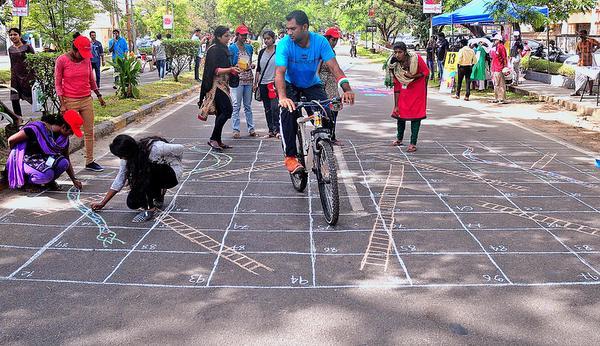
KOCHI: The otherwise busy Panampilly Nagar Road became a festival zone on Sunday, which was observed as car-free day on the street. People thronged crossroads 9 to 13 at Panampilly Nagar and took part in the various cultural and sports activities arranged by the organisers - the Kochi Corporation, Kochi Metro Rail Limited, ESAF, Rajagiri College of Social Sciences, Panampilly Nagar Welfare Association, City Police and Cochin Shipyard.
It was to declare that the streets belonged to pedestrians, cyclists, children, the aged and the physically challenged.
Residents of Panampilly Nagar and the nearby areas turned up and participated in activities such as flash mob, street play, kite flying, caroms, shuttle badminton, awareness programmes, cycle rally, folk arts performances and aerobics from 2 pm to 6 pm, turning  the crossroads into a temporary ‘stage.’ Rajagiri Hospital conducted a free medical camp as part of the programme.
Kochi Mayor Soumini Jain inaugurated the Car-free Day. It is the first time car-free day is observed in Kochi. The primary objective of the programme was to discourage use of private vehicles and promote public transport, thereby making the roads pedestrian/cycle friendly.
http://www.newindianexpress.com/cities/kochi/Kochi-street-turns-gala-zone-on-car-free-day/2016/09/26/article3629735.ece

Sunday, 25 September 2016

A UNIQUE ENDEAVOUR

I have read about how Gurmeet Singh cared for the patients in a Government Hospital in Patna earlier. The attitude that even I find difficult to achieve. However I soon forgot. Now I think he will be remembered for long. Read more to know...


As Patna celebrated the three-day International Sikh Conclave, Gurmeet Singh was getting a cotton shirt and trousers stitched, his first in six years. The sexagenarian Sikh, who hasn’t stepped out of Patna for 13 years, is preparing to receive this year’s World Sikh Award in London, having been picked out of 100 entries from all over the world in the category “Sikhs in Seva” by a London based organization, The Sikh Directory. For over 20 years Gurmeet Singh has been visiting the lawaris or the abandoned patient’s ward of Bihar’s biggest government hospital every night with food, medicine and compassion for poor patients who have no one to turn to. At the lawarisward patients wait for this Good Samaritan Sikh as someone waits for their angel.
On Wednesday night when The Hindu accompanied Gurmeet Singh to the ward in Patna Medical College and Hospital where there were 11 patients waiting for him. There were no signs of a doctor or nurse in the ward which was stinking with streams of urine and pale blood on the floor. A fetid smell of untouched left-over food given free by the hospital filled the air.

In the dimly-lit ward with lime-green walls, the faces of the patients light up when Gurmeet Singh steps in at 9 every night. “He is like God for us,” says Shanti Devi in a white loose dress. She has been in the ward with her infected leg for the last 15 days. “If Sardarji would not have been coming with food and medicine every night many of us have died,” she says, wolfing down fresh bread, vegetable and a sweet Gurmeet Singh has brought.It is her first meal of the day.
On the other bed in the room, there is a poor old woman from South India, her torn sari barely covering her. She can’t speak Hindi but seeing Gurmeet Singh she manages to sit up smile wanly. Opposite her, an emaciated, bedraggled woman with wild hair and a faded yellow petticoat is struggling to feed a tiny baby in her lap. She looks vacant and though she tries to speak, her voice fails her in every attempt. “She is mentally unsound…delivered the baby 10-days ago…”, says a voice from the next bed where an old lady with a bandage in her left hand sits. In another room Chandra Bhushan Kumar, Dev Prakash Mishra, Bhola Prasad and a mute old man who can’t get up, are waiting for Gurmeet.
Every night riding on his white scooty Gurmeet Singh leaves his small garment shop in the busy Chiraiyatand, buys food packets from a roadside “Radhe Krishna” eatery, near Gandhi Maidan, stops at Braj Ballabh Ghosh, a wheel cart sweet shop at the busy Ashok Rajpath. Sometimes Gurmeet buys eggs instead of sweets for a “change of taste”. With his bag full, he enters the PMCH’s “abandoned” ward, washes his hands in the wash basin takes out the steel plates he has kept there and serves food to the waiting patients.
Then he goes through the prescriptions of the patients and jots down the names of expensive medicines which he will buy. Gurmeet has lost count of the number of times he has donated blood for them. This is his unwavering routine. “Now, the doctors have told me not to donate blood anymore as it will be dangerous for my health…my son and other relatives donate. But sometimes when emergency comes, how can I not?” he says simply. Asked if anything had changed in this hospital in the last 20 years, he says, “Nothing.”
Fearing bad publicity, hospital authorities had banned his entry twice but each time his services were resumed after the intervention of respective District Magistrates. “He is among those rare persons who do selfless service to the human kind…very soon we’re going to honour him with our Prerna doot (Inspiring messenger) award”, Patna DM Sanjay Kumar Agrawal told The Hindu.
How does he manage? “There is a donation box in our house. Our family of five brothers put away 10 per cent of our monthly earnings in it. Our children do not celebrate birthdays or burst crackers during Diwali” Gurmeet says.
But as November 19, the day he will receive the award nears, Gurmeet is worried. Who will take care of the patients when he is gone to London? And how will he speak. As he puts it, “I do not know English, sir!”